A battery-powered gas detector is a sensor enclosed within a power budget. The sensor determines whether the budget can close at all; the display, alarm devices, radio and regulator determine whether it does so in practice. This guide presents a working method for portable instruments — clip devices, handheld leak detectors and compact battery units: what enters the budget, the source of each figure, and why the result must be measured. The reasons infrared sensing can be low-power, and how the MIPEX range compares in milliwatts, are addressed in Low-Power Gas Sensors: Power Budget, Battery Life and Duty Cycling.
Why a portable gas detector budget is built in microamps
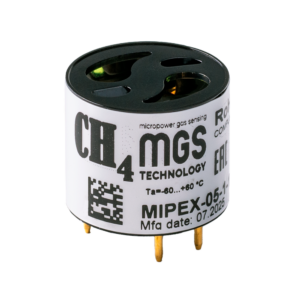
Batteries are rated in charge — milliamp-hours — whereas sensor documentation frequently quotes power in milliwatts. Power depends on supply voltage, which varies as the cell discharges. For a battery-powered gas detector, the more useful parameter is therefore average current. MIPEX datasheets publish this directly: MIPEX-04 draws 35 µA maximum under normal conditions, and MIPEX-05 draws less than 60 µA during continuous concentration measurement. Working in current keeps every line of the budget in the same unit as the battery.
The resulting arithmetic is straightforward and worth stating explicitly: estimated runtime equals usable battery capacity divided by the average current of the complete instrument. Both terms conceal most of the engineering effort. «Usable» capacity depends on cut-off voltage, temperature and peak load; «complete instrument» refers to every block in every state, weighted by the time spent in each. The remainder of this guide addresses both terms.
The power budget worksheet for a battery-powered gas detector
A budget that closes on paper but fails on the bench typically omits a consumer rather than misjudging one. The reliable method is to construct it by operating state — normal monitoring, alarm, user interaction and start-up — and to list every consumer in each state with its current and the proportion of time spent there:
- Gas sensor — average current from the sensor datasheet, plus peak current for supply design.
- Host microcontroller — sleep current for most of the duty cycle, active current during each poll and alarm evaluation.
- Display and backlight — frequently the largest normal-state consumer if left enabled.
- Alarm devices — buzzer, indicator LEDs and vibration motor, budgeted for the alarm state and for periodic self-test.
- Radio — budgeted per transmission.
- Regulator, battery gauge and protection — quiescent currents that operate continuously and are easily overlooked.
Only the first entry is derived from the gas sensor documentation. The remainder come from the datasheets of the other components and from the firmware design. The purpose of the worksheet is to make the sensor contribution visible in proportion: with a sensor below 60 µA, the remaining entries determine runtime.
Sensor current in a portable gas detector: MIPEX figures compared
The table lists the published current, supply and response figures for MIPEX sensors used in battery-powered instruments, with MIPEX-02 included for contrast as the fixed-installation model.
| Model | Average current | Supply voltage | T(90), CH4 | Intended instrument |
| MIPEX-04 | 35 µA max (40 µA max at −40…+60 °C) | +2.8…+5.0 V | ≤ 22 s | clip detectors, portable devices, IoT (IIoT) |
| MIPEX-04 ppm | less than 100 µA | +2.5…+5.0 V | ≤ 22 s | low-concentration leak detectors |
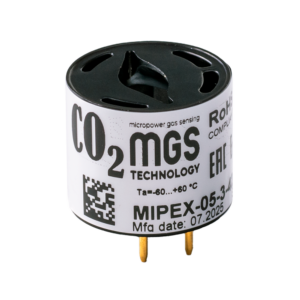
| MIPEX-05 | less than 60 µA; peak 4 mA max | +2.7…+5.0 V | ≤ 15 s | portable and wireless instruments |
| MIPEX-05 ppm | less than 150 µA | +2.7…+5.0 V | ≤ 15 s | low-concentration leak detectors |
| MIPEX-06 | less than 60 µA; peak 4 mA max | +2.7…+5.0 V | ≤ 15 s | portable and wireless instruments |
| MIPEX-1H (in development) | 80 µA max | +2.7…+5.0 V | ≤ 10 s | small-sized portable detectors |
| MIPEX-02 | ≤ 750 µA | +3.0…+5.0 V | ≤ 15 s | fixed gas detectors |
Peak current and supply design in a battery-powered gas detector
Average current determines the battery budget; peak current determines whether the instrument survives the moment of measurement. MIPEX-05 draws a peak current substantially higher than its average of below 60 µA, and the alarm devices of a portable gas detector add considerably larger pulses when a buzzer and a motor start simultaneously. A cell has internal resistance, which increases as it discharges and as its temperature falls. Consequently, each pulse momentarily pulls the terminal voltage down.
The design rule is that the lowest instantaneous voltage — under the worst combined pulse, at the lowest operating temperature and near the end of discharge — must remain above the minimum supply voltage of both the sensor and the host. For MIPEX-05 that floor is +2.7 V; for MIPEX-04 it is +2.8 V. Local decoupling near the sensor and an alarm sequence that does not activate every load simultaneously are less costly than specifying a larger cell. The MIPEX-04 documentation provides a voltage drop diagram, which serves as the reference for this check.
Cut-off voltage: how much of the battery a portable gas detector can use
The minimum supply voltage is not solely a reliability limit. It also determines how much of the cell’s charge is usable. A single lithium cell of the common chemistries spends most of its discharge within a 2.7–5.0 V window, so MIPEX-05 can operate from it directly to near the end of its useful life. Two alkaline cells in series behave differently: they begin near 3 V and spend a large proportion of their discharge below 2.7 V, so a detector built on them either requires a boost converter or leaves charge unused.
A regulator resolves the voltage problem and introduces a new budget line, since its quiescent current operates for the entire life of the instrument. For a sensor averaging below 60 µA, a regulator with a quiescent current of the same order effectively doubles the sensing cost. The preferable design, where the cell chemistry permits, is to operate the sensor directly from the battery; a supply window extending down to 2.7 V therefore makes MIPEX-05 suitable for direct-from-cell portable designs.
Warm-up and start-up in a battery-powered gas detector budget
A portable gas detector is switched on and off by its user, and each start consumes both time and charge. MIPEX-05 specifies a warm-up time of up to 120 seconds before the reading is valid. During this period the instrument must remain powered, indicate to the user that measurement is not yet available, and suppress gas alarms that a settling reading might otherwise trigger.
For a device used daily, this constitutes a small, fixed entry in the start-up state. It becomes significant only when firmware attempts to conserve energy by switching the sensor off between readings: the warm-up is then paid on every cycle and creates a blind window each time. For a personal safety detector, the practical approach is to warm up once at switch-on and then measure continuously.
Alarm reserve and temperature margin in a portable gas detector
A detector whose battery is exhausted during an alarm has failed at the critical moment. The budget therefore requires a reserved block of charge that is not counted towards normal runtime: sufficient to operate the alarm devices for a defined period after the low-battery warning appears, plus the warning itself. The required duration is determined by the instrument standard and the customer’s procedure, not by the sensor; alarm levels and their purpose are addressed in LEL Monitoring 101.
Temperature introduces a second constraint. Cell capacity decreases in the cold while internal resistance increases, so both the usable charge and the peak-voltage margin are reduced simultaneously. The sensor side of this is documented: MIPEX-04 is specified down to −40 °C, and MIPEX-05 is specified down to −60 °C. MIPEX-04 states its current at the extremes of its range. The battery side must be derived from the cell manufacturer’s low-temperature data, which is why the runtime of a portable gas detector should always be stated together with the temperature at which it was calculated.
What published figures say about portable gas detector runtime
The energy-efficient design of MIPEX-04 enables compact instruments to operate autonomously for over two years on a single battery, and its documentation describes a clip gas detector lasting more than 24 months without charging. Published material also relates current to service life: an average current below 35 µA makes a two-year non-serviceable clip detector feasible, and a ppm-range optical sensor drawing below 100 µA supports twelve months of battery life in a portable leak detector. These are instrument-level statements, valid for a design that maintains the remaining budget entries in proportion.
A runtime calculator is not published here, because the cell, its capacity at temperature, the display and the alarm reserve are determined by the instrument manufacturer. What is provided is a method to measure rather than to estimate. The MIPEX Evaluation Kit is intended, among other purposes, for battery-life estimation in IoT and IIoT sensor node designs and for laboratory tests of power consumption and response time; the MIPEX interface board for MIPEX-02 and MIPEX-05 supports sensor current measurement. A budget confirmed on that hardware is one on which a product launch can rely.
Where power budgeting for battery-powered gas detectors stops
A power budget is a model, and its limitations merit explicit statement. Datasheet currents are specified under defined conditions — polling rate, temperature, supply — and a design operating outside those conditions falls outside the specified figure. Self-discharge and ageing of the cell are properties of the battery and may dominate a multi-year budget irrespective of how economical the electronics are. Average current provides no information about the peak, and the peak determines end-of-life behaviour. Moreover, no budget substitutes for a measurement on the finished instrument, at the lowest rated temperature, with the alarm sequence included.

Portable gas detector power budget: questions engineers ask
How do I estimate the runtime of a battery-powered gas detector?
Divide the usable battery capacity by the average current of the complete instrument, with every consumer weighted by the time spent in each operating state. Usable capacity depends on the cut-off voltage, temperature and peak load; the estimate should therefore be confirmed by measurement on actual hardware.
How much current does a MIPEX sensor draw in a portable gas detector?
MIPEX-04 draws 35 µA maximum under normal conditions and 40 µA maximum across −40…+60 °C. MIPEX-05 draws less than 60 µA at constant measurement. The ppm variants draw more: below 100 µA for MIPEX-04 ppm and below 150 µA for MIPEX-05 ppm. Peak current is substantially higher than the average and must be accounted for in supply design.
Can a portable gas detector run its sensor directly from the battery?
With a single lithium cell, this is generally feasible: MIPEX-05 operates from +2.7 to +5.0 V and MIPEX-04 from +2.8 to +5.0 V (one version; another version supports +2.5 V). Two alkaline cells in series spend a significant proportion of their discharge below 2.7 V, so such a design typically requires a boost converter, whose quiescent current then enters the budget.
Why does warm-up time matter in a battery-powered gas detector?
Because the reading is not valid until warm-up is complete. MIPEX-05 specifies up to 120 seconds. In a detector that warms up once at switch-on, this represents a small start-up cost; in a design that switches the sensor off between readings, it is incurred on every cycle and leaves the instrument without valid measurement each time.
How long can a clip gas detector run on one battery?
Battery-powered detectors with integrated recordly-low power MIPEX-04 can last more than 24 months without charging. The result for a specific product depends on the display, alarm devices, radio and cell, and should be confirmed with the MIPEX Evaluation Kit or an equivalent current measurement.