
Carbon dioxide (CO2) is a ubiquitous industrial gas whose concentration must be continuously monitored to ensure safety, process stability and indoor air quality. In many enclosed or hazardous environments elevated CO2 concentrations can impair worker health, disturb production processes and, at high levels, cause oxygen displacement. For reliable carbon dioxide detection and quantitative control, NDIR CO2 sensors are the preferred technology in modern gas detection systems.
Why choose an NDIR CO2 sensor (infrared CO2 sensor)?
NDIR (non‑dispersive infrared) carbon dioxide sensors detect CO2 by measuring selective absorption of infrared radiation at wavelengths characteristic for the CO2 molecule.
Compared with electrochemical or metal‑oxide alternatives, an ndir co2 sensor provides:
- high accuracy and stability over time, enabling a high accuracy CO2 sensor performance with low drift;
- long service life and reduced calibration frequency, lowering total cost of ownership for industrial CO2 monitoring;
- immunity to many poisoning and cross‑sensitivity mechanisms;
- capability to measure across wide CO2 ppm ranges and up to percent‑level concentrations required in some process applications.
Technical attributes and measurement performance
A typical ndir carbon dioxide sensor comprises an IR source, optical path (fixed length or folded), optical filters tuned to CO2 absorption bands, and a photodetector with signal conditioning. The detector output is linearized and compensated for temperature, pressure and aging using on‑board processing. Key specification items to compare when selecting a CO2 gas sensor or CO2 gas detector include: detection range (ppm or % vol), accuracy and repeatability, response time (T90), power consumption (important for low power CO2 sensor applications), interface type (analog, digital, UART, I2C), and environmental ratings (operating temperature, humidity, ingress protection).
MIPEX family — infrared carbon dioxide sensor solutions from MGS
MGS Technology’s MIPEX line illustrates typical implementations of ndir co2 technology adapted for industrial use:
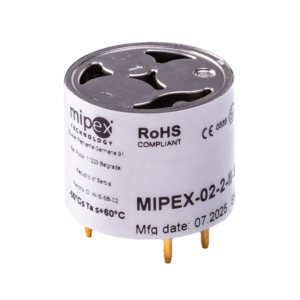
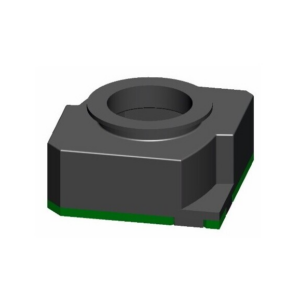
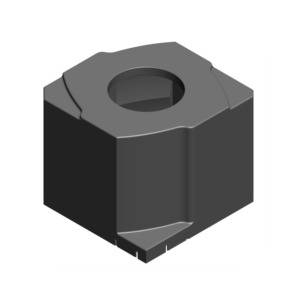
- MIPEX‑02 (carbon dioxide gas sensor): a universal optical CO2 sensor intended for stationary and portable CO2 gas analyzer applications. Available in metal or polycarbonate Lexan™ 4‑series housings, MIPEX‑02 delivers low power consumption (below 2.5 mW), dust resistance and extended operating range for use in mining, metallurgy, oil & gas and other industrial environments.
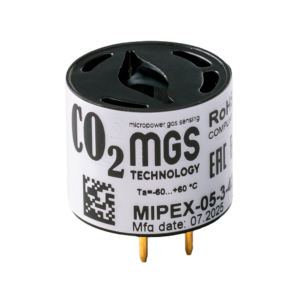
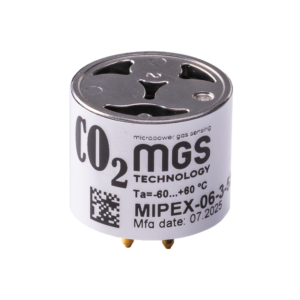
- MIPEX‑05 (ultra‑low power CO2 sensor): a miniature ndir CO2 module in 4‑series format designed for continuous automatic measurement in hazardous areas. MIPEX‑05 includes an integrated microcontroller for linearized, temperature‑compensated outputs, supports extended CO2 ranges (up to ~10% vol in calibrated mode), and achieves intrinsically safe ratings suitable for many process installations. Its low power profile makes it an attractive option where a low power CO2 sensor is required.
Both modules are suited for integration into CO2 gas detectors, gas detection units, and CO2 gas analyzers. Their optical CO2 sensor architecture supports robust carbon dioxide detection even under challenging field conditions.
Application areas and system integration
Industrial CO2 sensors and CO2 gas detectors are used across multiple domains:
- process control and safety in chemical plants, food processing, HVAC systems;
- environmental monitoring and emission sensors for regulatory reporting;
- confined‑space and underground operations (mines, tunnels) where CO2 level sensor functionality is critical;
- portable and fixed gas detection equipment and gas proving units for plant safety routines.
When integrating an ndir CO2 sensor into a system, engineers should consider sampling strategy (diffusion vs pumped), optical pathlength selection for desired sensitivity, calibration procedures, and communications. Digital CO2 sensors with smart sensor functionality simplify integration into IoT stacks and SCADA (CO2 sensor in iot / CO2 smart sensor use cases), enabling remote telemetry, trend analysis and alarm management.
Selecting the right CO2 sensor: practical criteria
- Range and resolution: choose co2 ppm sensor capability or percent‑level range according to the detection objective (indoor air quality vs process headspace).
- Power and form factor: a low power CO2 sensor or miniature CO2 sensor may be mandatory for battery‑powered or portable detectors.
- Accuracy and stability: a high accuracy CO2 sensor reduces calibration frequency and false triggers.
- Environmental robustness: ensure sensor ndir co2 modules meet temperature, humidity and particulate exposure requirements.
- Support and compliance: work with co2 sensor manufacturers that provide technical data, calibration support and relevant safety/explosion certifications where required.
Commercial and procurement notes
For procurement, consider whether you need a stand‑alone CO2 gas sensor module or a complete CO2 gas detector package. Many customers choose to buy a proven ndir carbon dioxide sensor module to embed into a custom gas measuring instrument; others prefer turnkey CO2 gas detector units. Evaluate vendor documentation for co2 sensor range, calibration certificates, expected lifetime and service options prior to purchase (CO2 sensor buy).
Conclusion
NDIR CO2 sensors deliver reliable, accurate carbon dioxide detection suited to a broad range of industrial applications. MIPEX series sensors from MGS provide compact, low power, and high‑accuracy options for both portable CO2 gas detectors and stationary gas detection equipment. For system designers requiring infrared CO2 sensor modules or complete methane/CO2 gas analyzers, selecting sensors with the right range, power profile and integration features is critical to ensuring safe operations and regulatory compliance.